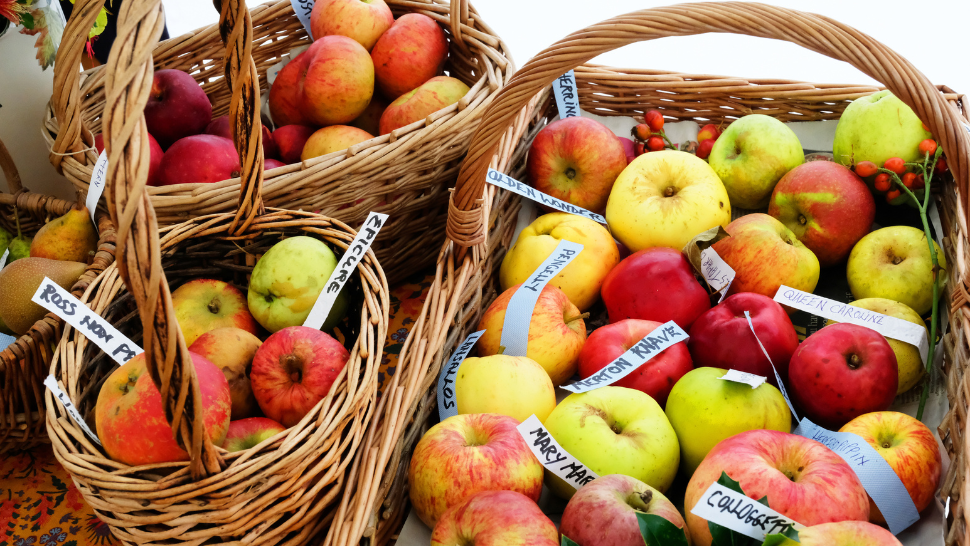
If you’ve ever stood bewildered in front of a farmer’s market apple stand, wondering whether to go for the Ashmead’s Kernel or the Hudson’s Golden Gem, you’re not alone. The sheer variety of apples, from sweet, tart, crisp, or mealy to every blush in between, is more than a fruit salad of flavors. It’s a delicious metaphor (and actual mechanism) for biodiversity, resilience, and a sustainable food future.
A fruitful spectrum of flavor and function. In the U.S., we grow hundreds of types of apples, but only a handful of varieties dominate grocery store shelves. While Red Delicious, Honeycrisp, and Gala might hog the spotlight, heirloom and lesser-known varieties like Arkansas Black, Calville Blanc d’Hiver, and Gravenstein are the real stars of biodiversity.
Each apple varietal brings its own genetic quirks. Some store well through the winter and some (looking at you, Winesap) have been wooing cider makers for centuries. This diversity isn’t just a boon for taste buds; it’s insurance for our food system. Genetic variety in crops helps protect from pests, diseases, and the ever-more-frequent curveballs of climate change.
Apples vs. the monoculture menace. Monocultures, the agricultural equivalent of putting all your apples in one basket, are vulnerable. Planting vast swaths of genetically identical crops invites pests and diseases to the party. To keep them away, industrial farms often rely on synthetic fertilizers and pesticides, which come with environmental side effects that can lead to soil degradation, water pollution, and greenhouse gas emissions.
Now imagine an orchard filled with a rainbow of apple types, each with its own strengths. Some resist fungal infections, others handle drought like champs, and some produce steadily even in unpredictable weather. That’s the sustainable orchard of the future, and it looks a lot like the past.
Seedling heroes. Many heirloom apples have been passed down through generations, grown not for shelf life but for stories, seasons, and soul. By seeking out apples like the Newtown Pippin or Roxbury Russet, you’re not just indulging your inner apple nerd, you’re helping keep them alive and in cultivation.
Without eaters who appreciate these varietals, they risk vanishing. And when an apple disappears, it’s not just a fruit we lose — it’s an entire lineage of flavor, farming knowledge, and potential resilience.
More than just a pretty peel. Diverse apple varieties support local economies and small-scale farming. Many heirloom apples are grown in smaller orchards by farmers who use ecologically sound practices. These orchards often act as biodiversity hotspots, supporting pollinators and healthy soil systems that industrial farms can’t match.
Plus, buying local apples reduces the carbon footprint associated with storage and transportation. Unlike apples shipped across hemispheres and held in cold storage for months, local varieties tend to be fresher, tastier, and more environmentally friendly.
So, what can you do? (Besides eating more apples — which, yes, please!)
- Go beyond the grocery store. Farmer’s markets and community-supported agriculture (CSA) boxes are prime places to discover rare apple varietals.
- Ask for the weird ones. If you see an apple with a funny name and a gnarly shape, give it a chance. It’s probably delicious and certainly doing more for biodiversity than your standard Granny Smith.
- Support heritage orchards. Many small farms offer mail-order options for heirloom apples. Your taste buds and the planet will thank you.
- Grow your own. If you’ve got space, consider planting a lesser-known variety. Many apple trees are well-suited to backyard growing, and you can graft multiple types onto one tree for maximum snack potential.
Eating different apples is like swiping right on sustainability. It’s a small act with juicy rewards like preserving biodiversity, reducing agricultural risk, and promoting eco-friendly farming practices. So, get to know your Spitzenburgs, flirt with a Fameuse (also known as a Snow Apple), or fall in love with a Liberty. Your apple a day might just help keep environmental collapse away.